
Africa-Europe Innovation Dialogues 2026: highlights from Abidjan
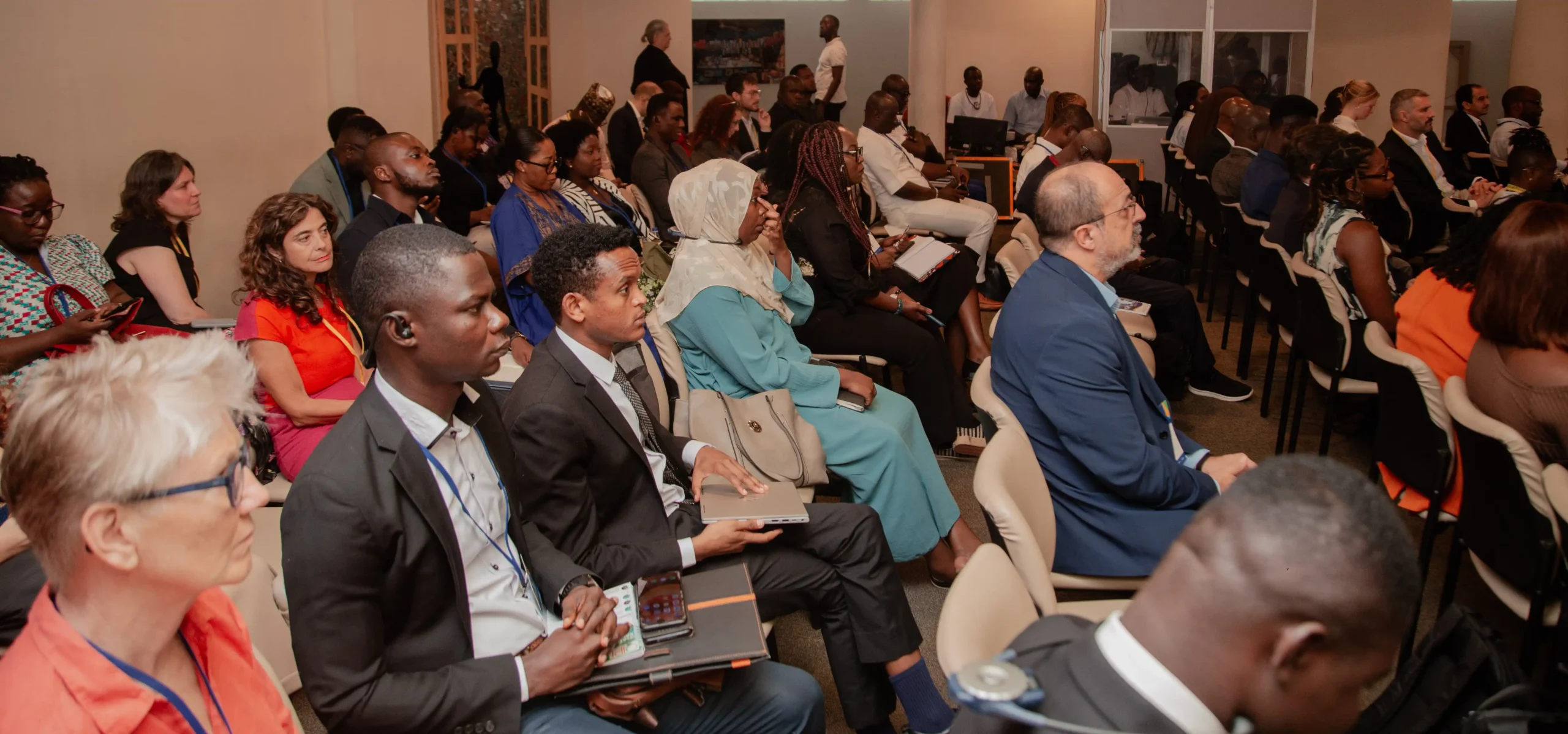
Abidjan, 3 and 4 November 2026 – The Africa-Europe Innovation Platform (AEIP) brought African and European research and innovation stakeholders together on 3 and 4 November 2026 in Abidjan, Côte d’Ivoire, for the second Africa-Europe Innovation Dialogues. Held on the African continent for the first time, the conference provided an opportunity to reflect on progress and explore the next steps for cooperation. Across two days of panels, workshops and presentations, one message kept returning: the ecosystem is not short of initiatives. What it needs now is for them to connect.
As the “network of networks”, the AEIP connects African and European researchers and innovators, and strengthens links between existing initiatives within the framework of the AU-EU Innovation Agenda. More than 250 researchers, entrepreneurs, policymakers and support organisations participated in person or online, with simultaneous interpretation between English and French.
Networking ran throughout the event. Using a matchmaking app, participants arranged meetings at dedicated meeting points based on each other’s profiles, offers and requests. One week after the Dialogues, an online matchmaking day connected in-person and online participants. In total, almost 300 connections were made with the matchmaking app.
Setting the stage
Stephan Kreutzer (Technopolis Germany) and Stephanie Abogne (Technopolis Africa) opened the conference with a live poll. It showed an audience spanning Europe and Africa, with diverse stakeholder groups represented. When asked what they hoped to gain, participants put new partnerships at the top of the wish list.
Carole Demol, Deputy Head of the EU Delegation to Côte d’Ivoire, welcomed participants with three messages: scientific cooperation should be a driver of sustainable development, the AU-EU Innovation Agenda should be implemented with particular attention to African priorities, and two days of dialogue should lead to concrete results. Such a partnership, she said, rests on reciprocity, trust and building projects together.
Olivier Avoa, Director-General for Digital Transformation and Digitalisation, Ministry of Digital Transition and Technological Innovation of Côte d’Ivoire, linked the conference to Côte d’Ivoire’s national development plan and its digital acceleration plan. For ideas to become reality, he named three requirements: bringing research, innovation and the market closer together, using partnerships to help innovative companies scale up, and putting skills, trust and digital sovereignty at the heart of innovation. Africa, he stressed, is not only a place of needs but also of talent, experimentation, entrepreneurship and economic opportunity.
The co-chairs of the AU-EU Innovation Agenda Working Group joined by video. Lukovi Seke (AUDA-NEPAD) recalled the Agenda’s priority areas, while Vincenzo Lorusso (European Commission) delivered his message as slam poetry. He called on the importance of taking stock of the Agenda, which was adopted in July 2023 and is reaching the end of its short-term actions.
A family of initiatives
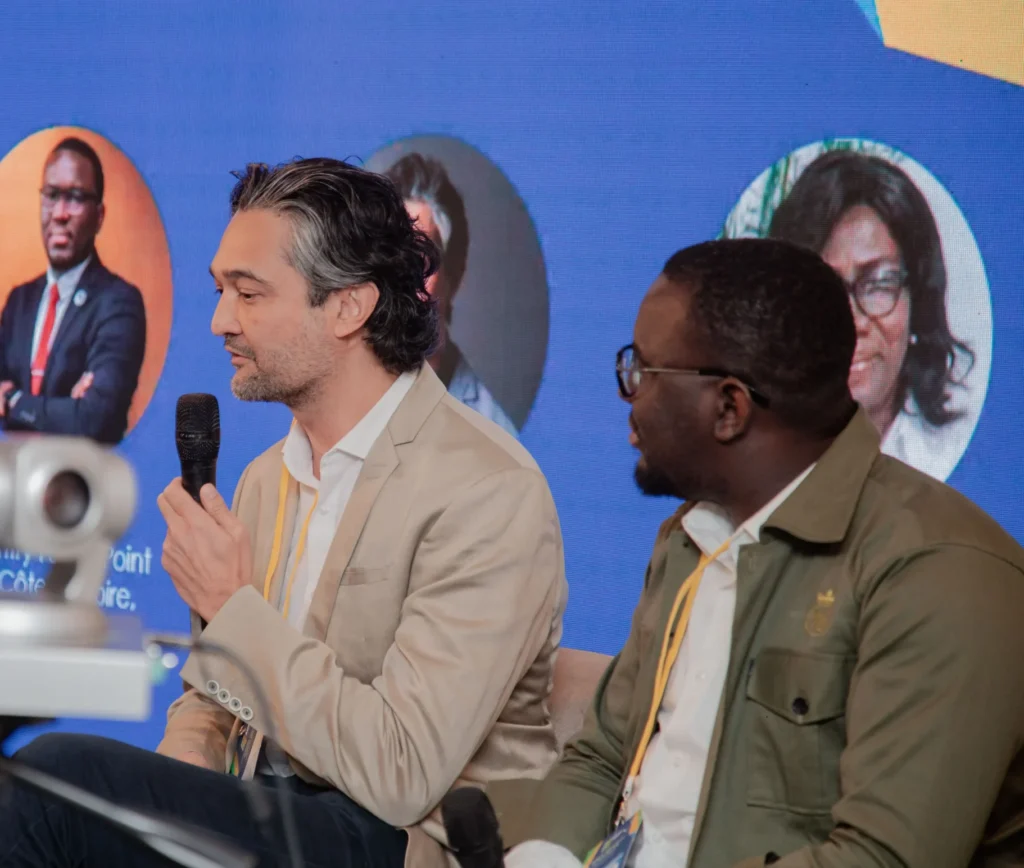
During the first session of the conference on the Africa-Europe Innovation Ecosystem, moderator Matthias Ploeg (Technopolis Netherlands) compared the ecosystem to a family whose members support one another (but sometimes also get in each other’s way). Three sister initiatives showed what that looks like in practice: AEDIB on digital innovation, CEA-FIRST on food systems and LEAP-SE on sustainable energy. Each presented how it connects African and European partners, from researchers and support organisations to start-ups and investors.
Looking ahead, the panel saw the greatest opportunities in early-stage funding, closer links between research and the private sector, and the inclusion of women and young people. Its advice to start-ups looking for investment was to seek out partners and networks. As panellist Irene Annor-Frempong (CEA-FIRST) put it: “Don’t stay in your cocoon.”
The Côte d’Ivoire experience
The national ecosystem panel brought these themes into the context of the host country. Representatives from public institutions and organisations supporting innovation, entrepreneurship and higher education in Côte d’Ivoire discussed how to connect existing initiatives and strengthen collaboration between governement, universities and the private sector, particularly small and medium-sized enterprises.
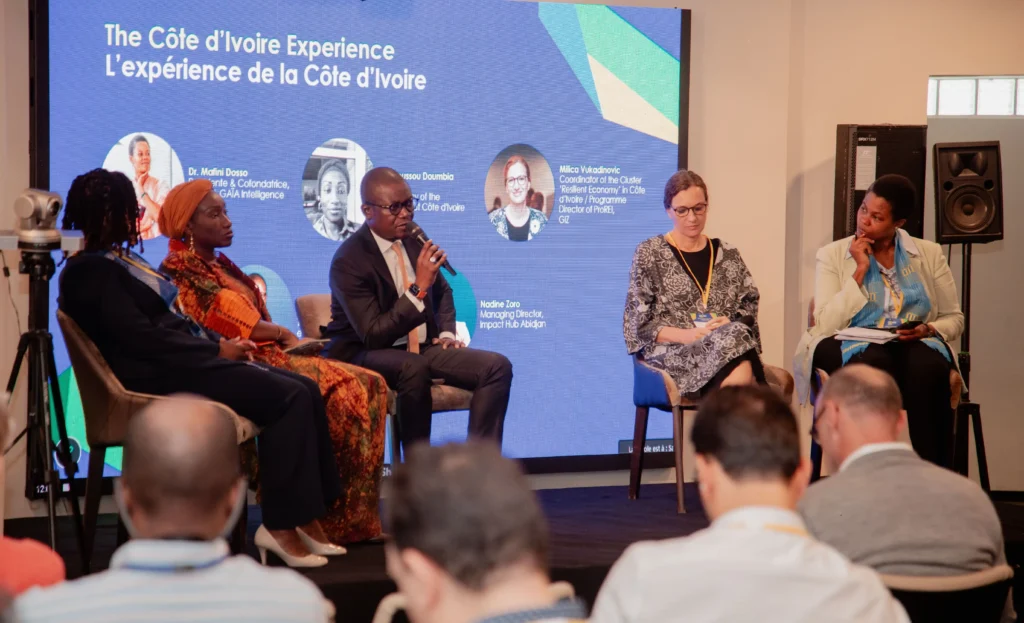
Three interconnected priorities emerged: education, entrepreneurship and the valorisation of knowledge. Panellists emphasised that innovation policies and programmes need to address these dimensions together, contributing not only to technological development but also to economic growth and employment.
Pitches, opportunities and winning matches
The afternoon belonged to the participants. In the Nano Pitches session, around twenty innovators had one minute each to showcase their ideas. These ranged from a fertiliser alternative made from volcanic rock in Cameroon to AI-assisted emergency care coordination in Nigeria.
In parallel sessions, participants took stock of the AU-EU Innovation Agenda as its short-term actions draw to a close. Their input will feed a brief for the Agenda’s Working Group. Others joined the venture capital masterclass by VC4A and Digital Africa and the Matchmaking Café led by AfriLabs.
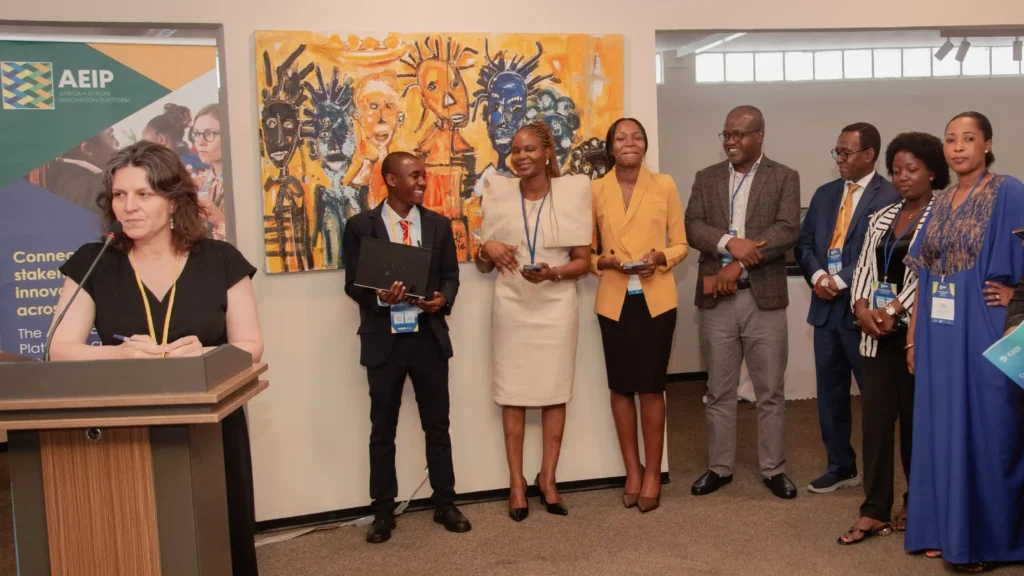
The winning pairs of the first two AEIP Thematic Challenges, on Green Transition and Public Health, presented what they have built since being matched. Among them: a Ugandan-Spanish alliance turning plastic waste in Arua, Uganda into 3D-printed school furniture, and a Ugandan-Dutch team developing a voice-based early warning system for malaria in hard-to-reach communities. Together, the two challenges attracted around 400 applications, resulting in 37 solutions and 3 winning pairs selected for each Thematic Challenge.
The session also launched the third and final Thematic Challenge, on AI in science. It covers the responsible use of AI, research integrity, data for science and AI-powered research. All innovation actors, including BSOs, SMEs, corporates, academia, policy makers, civil society organisations, are invited to submit their Expression of Interest by 15 January 2027.
Day 2: from dialogue to action
The second day turned to smaller, hands-on workshops. In the Youth Entrepreneurship Lab, led by The Youth Café, young and women entrepreneurs explored what a fair Africa-Europe circular economy could look like. They proposed dedicated guarantee funds and simplified seed grants for young founders, flexible acceleration programmes for women, and partnerships built on co-investment and shared intellectual property. In parallel, SARIMA’s World Café brought academia, industry and civil society together to discuss trusted, equitable links between the two continents.
Later sessions looked at how ecosystems turn ideas into companies and careers. The AAU-led session on the AEIP Communities of Practice shared how members have exchanged knowledge throughout the project, while EBN explored venture building with the resources ecosystems have at hand. An investor panel discussed access to capital for start-ups and SMEs, and a session on qualifications recognition looked at how it can support research collaboration, innovation and employability. Site visits to Hub Ivoire Tech and a Horizon Europe information session at Université Félix-Houphouët-Boigny closed the programme.
The ideas and partnerships sparked in Abidjan do not end with the conference. Join the AEIP digital space to find partners, funding opportunities and stay informed about upcoming activities. Thank you to everyone who came to Abidjan, pitched, discussed and connected: we look forward to continuing the dialogue.
SAVE THE DATE
Africa-Europe Innovation Dialogues 2027
22 and 23 June 2027 | Coimbra, Portugal
After Brussels and Abidjan, the Dialogues travel to Coimbra, Portugal. More details will follow soon. We hope to see you there.